Turbulent Mixers vs Extrusion: Which Method is Best for Liposome Formation?

Liposomes have become essential tools in drug delivery, cosmetics, and research due to their ability to encapsulate active compounds within lipid bilayers. Choosing the right method to form liposomes can significantly impact their size, uniformity, encapsulation efficiency, and scalability. Two popular techniques for liposome formation are turbulent mixers (solvent injection) and extrusion methods. This article compares these approaches, highlighting their advantages, limitations, and practical applications to help you decide which method suits your needs best.
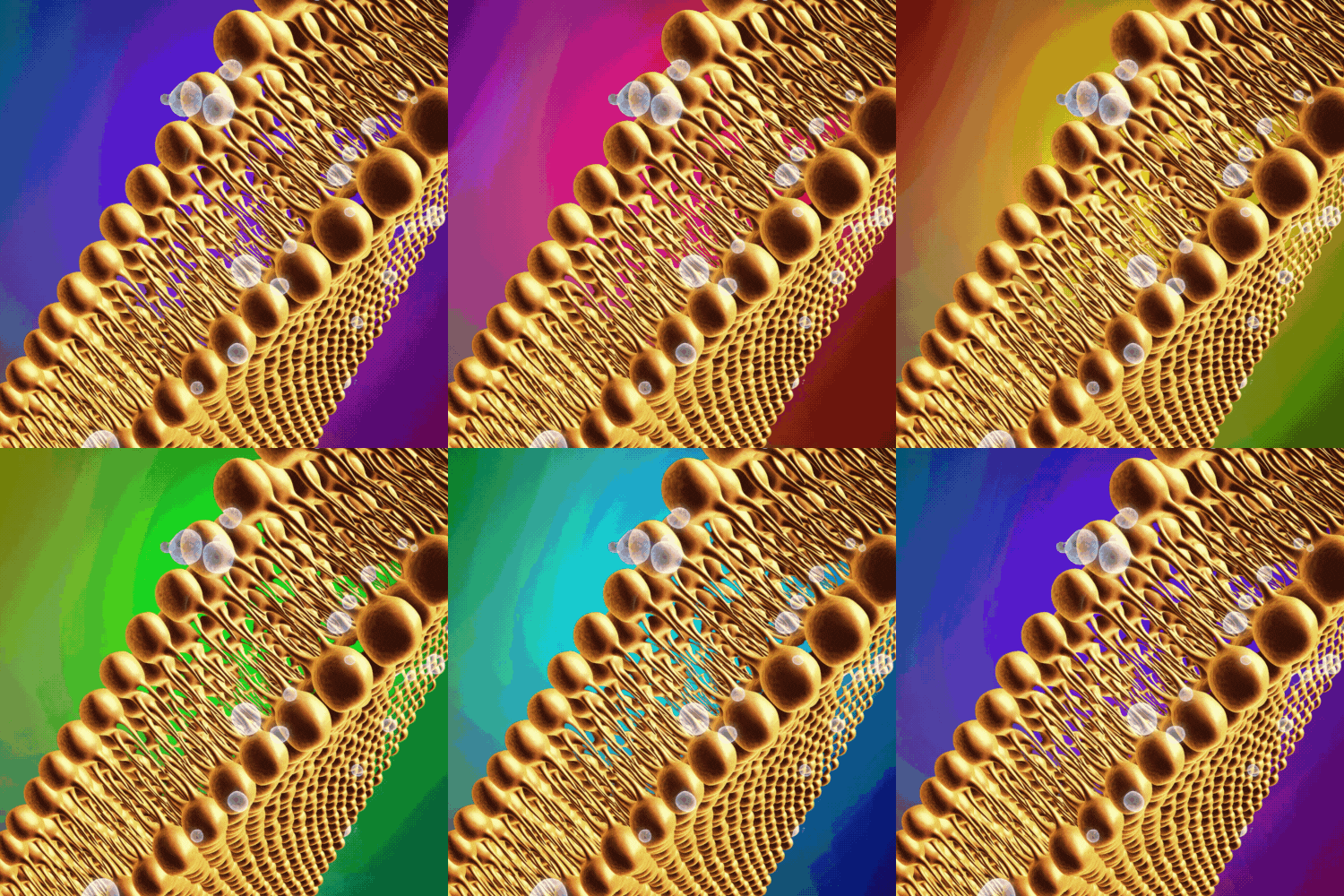
Understanding Liposome Formation
Liposomes are spherical vesicles with one or more phospholipid bilayers. Their size typically ranges from 50 nanometers to several micrometers. The formation process involves dispersing lipids in an aqueous environment, where they spontaneously assemble into bilayers. The method used influences the liposome’s characteristics, including:
Size distribution - refers to the average particle diameter and the breadth of that distribution, often expressed as polydispersity index. Liposome size influences circulation time, biodistribution, cellular uptake, and clearance pathways. Smaller vesicles, typically below 200 nanometers, are often preferred for systemic delivery due to improved stability in circulation and enhanced tissue penetration. A narrow size distribution improves reproducibility, predictability of biological performance, and regulatory compliance in pharmaceutical applications.
Lamellarity (number of bilayers) - describes the number of lipid bilayers forming each vesicle. Liposomes may be unilamellar with a single bilayer or multilamellar with multiple concentric bilayers. Unilamellar vesicles are commonly used for drug delivery because they offer more predictable release kinetics and higher encapsulation efficiency for certain payloads. Multilamellar vesicles may provide slower release profiles but can introduce variability in drug loading and performance.
Encapsulation efficiency - refers to the proportion of active ingredient successfully entrapped within the liposome relative to the total amount used during formulation. This parameter depends on lipid composition, preparation method, drug solubility, and loading strategy. High encapsulation efficiency reduces material waste, improves dose consistency, and supports cost effective manufacturing, particularly for expensive nucleic acids or biologics.
Stability - includes both physical and chemical stability over time. Physical stability relates to aggregation, fusion, size growth, or leakage of encapsulated material. Chemical stability concerns lipid oxidation, hydrolysis, and degradation of the encapsulated payload. Stability is influenced by lipid composition, surface modification, storage conditions, and buffer selection. Long term stability is essential for shelf life, transport, and clinical usability.
Selecting the right technique depends on the intended application, scale of production, and desired liposome properties.
How Turbulent Mixers Work
Turbulent mixers use rapid mixing of lipid-containing organic solvents with aqueous phases to form liposomes. The process often involves injecting a lipid solution dissolved in a solvent like ethanol into a high-velocity aqueous stream. The intense mixing causes the lipids to self-assemble into vesicles almost instantly.
Key Features of Turbulent Mixers
Rapid mixing: High mixing forces create uniform liposomes quickly.
Continuous process: Suitable for large-scale production with consistent output.
Solvent injection: Lipids are dissolved in a solvent, then injected into water, causing spontaneous vesicle formation.
Control over size: Adjusting flow rates and solvent ratios allows tuning of liposome size, often producing small unilamellar vesicles (SUVs, <100 nm).
Advantages
Scalability: Easily adapted for industrial-scale production.
Speed: Liposomes form within seconds, increasing throughput.
Reproducibility: Automated control of flow rates ensures consistent batches.
Low energy input: Does not require high pressure or extensive mechanical force.
Limitations
Residual solvent: Requires solvent removal steps to ensure purity.
Encapsulation challenges: Hydrophilic drug encapsulation can be less efficient due to rapid mixing.
Equipment cost: Initial investment in specialized mixers can be high.
How Traditional Extrusion Methods Work
Extrusion involves forcing a crude liposome suspension through membranes with defined pore sizes. This mechanical process breaks down larger, multilamellar vesicles into smaller, more uniform liposomes.
Key Features of Extrusion
Membrane filtration: Liposomes pass through polycarbonate or other membranes with pore sizes typically between 50 nm and 1000 nm.
Batch process: Usually performed in cycles, with repeated passes through the membrane.
Size control: Membrane pore size directly determines the final liposome size.
Improved uniformity: Produces liposomes with narrow size distribution.
Advantages
Simple setup: Requires basic laboratory equipment and membranes.
Decent encapsulation efficiency: Especially for hydrophilic compounds trapped inside the aqueous core.
Size uniformity: Produces liposomes with consistent size and lamellarity.
No organic solvents: Avoids solvent residues, improving biocompatibility.
Limitations
Labor-intensive: Multiple extrusion cycles increase processing time. Specially difficult to push through membranes with high melting temperature lipids.
Limited scalability: Difficult to scale up for industrial production.
Mechanical stress: Repeated extrusion can degrade sensitive molecules, lipids or pore membranes.
Comparing Liposome Size and Uniformity
Liposome size and uniformity are critical for stability and biological performance. Turbulent mixers typically produce small unilamellar vesicles with sizes ranging from 50 to 150 nm. The size can be tuned by adjusting flow rates and solvent-to-water ratios.
Extrusion allows precise control over size by selecting membrane pore sizes. For example, passing liposomes through a 100 nm membrane generally yields vesicles close to that size. The size distribution is often narrower than with turbulent mixers, which benefits applications requiring uniform delivery vehicles.
Encapsulation Efficiency and Stability
Encapsulation efficiency depends on the method and the nature of the encapsulated compound. Extrusion tends to provide higher encapsulation for hydrophilic drugs because the process starts with a lipid suspension containing the drug in the aqueous phase.
Turbulent mixers may have lower encapsulation efficiency for hydrophilic molecules due to rapid dilution and mixing, which can cause leakage. However, they perform well for hydrophobic drugs dissolved in the lipid phase, as well as nucleic acid via complexation with certain ionizable lipids.
Practical Considerations for Scale and Application
When to Choose Turbulent Mixers
You need small- to large-scale production with high throughput and future scalability.
The formulation involves hydrophobic drugs, nucleic acids or lipids dissolved in organic solvents.
You require batch-to-batch consistency.
You can accommodate solvent removal steps post-formation.
When to Choose Extrusion
Your focus is on small batch sizes or research-scale production.
You need high encapsulation efficiency for hydrophilic compounds.
You want precise control over liposome size and uniformity.
Avoiding organic solvents is a priority.

NOVA™ IJM for turbulent mixing-based liposome formation. 
TWIST™ Liposome Extruder for extrusion-based liposome formation.
Summary of Key Differences
Feature | Turbulent Mixing (Solvent Injection) | Extrusion (Mechanical Sizing) |
Primary Mechanism | Bottom-Up: Self-assembly occurs as an organic solvent (e.g., ethanol) is rapidly diluted into an aqueous phase. | Top-Down: Large, multilamellar vesicles (MLVs) are forced through polycarbonate membranes with defined pores. |
Scalability | High: Easily scaled using Impingement Jet Mixers or T-mixers | Low: Limited by membrane surface area and potential for clogging/fouling. Must transition to microfluidizers or homogenizers. |
Protein Integrity | Preserved: High protein incorporation; more stable for membrane-associated proteins. | Risk: High shear forces and mechanical stress can lead to protein loss or denaturation. |
Process Steps | One-Step: Mixing and formation happen simultaneously in a continuous flow. | Multi-Step: Requires initial thin film hydration, vesicle formation followed by multiple passes through an extruder. |
Solvent Residue | Requires downstream removal (e.g., dialysis or TFF). | Generally solvent-free if starting from pre-hydrated lipid films. |
Size Control | Governed by flow rate and turbulence intensity; often produces smaller particles. | Governed by membrane pore size; precise but manual. |
Liposome formation methods must align with your product goals, scale, and formulation needs. Both turbulent mixers and extrusion have proven effective but serve different purposes.

